
Digital Exclusion Blog
By Cath McNally
Corra is pleased to be supporting a review by Audit Scotland to consider how well public bodies understand and are tackling digital exclusion. In this blog, Cath explores digital exclusion and its impact on communities.
What is digital exclusion? How does if affect communites?
The pandemic had a significant impact on digital exclusion. As more and more activities moved online, people who were already digitally excluded found it even more difficult to access essential services and information. At the same time though the restrictions on people coming together led to an increased reliance on digital technologies as organisations and businesses moved their services online, making it difficult for people without access to the internet or digital devices to engage with them.
We saw this in our work in Getting Alongside Communities; at points during the pandemic our usually place-based Community Coordinators were not able to be in communities due to lockdowns. This moved their interactions with people largely into the online realm, and it became apparent very quickly that there were large groups of people that were then out of reach of the Coordinators. This included lots of older community members, children, young people, people whose first language is not English, those with limited or no internet access at home and those with limited skills and confidence in engaging with digital technologies.
This mirrors wider research from The British Academy on digital exclusion showing that it is strongly associated with poverty and other forms of inequality and disadvantage. Older people, women, young care leavers, people who are disabled, those experiencing poverty and minority ethnic communities are more likely to be at risk of digital exclusion. Poverty is a key driver with cost the main barrier to people getting online but a lack of infrastructure, particularly in rural areas, is also a challenge.
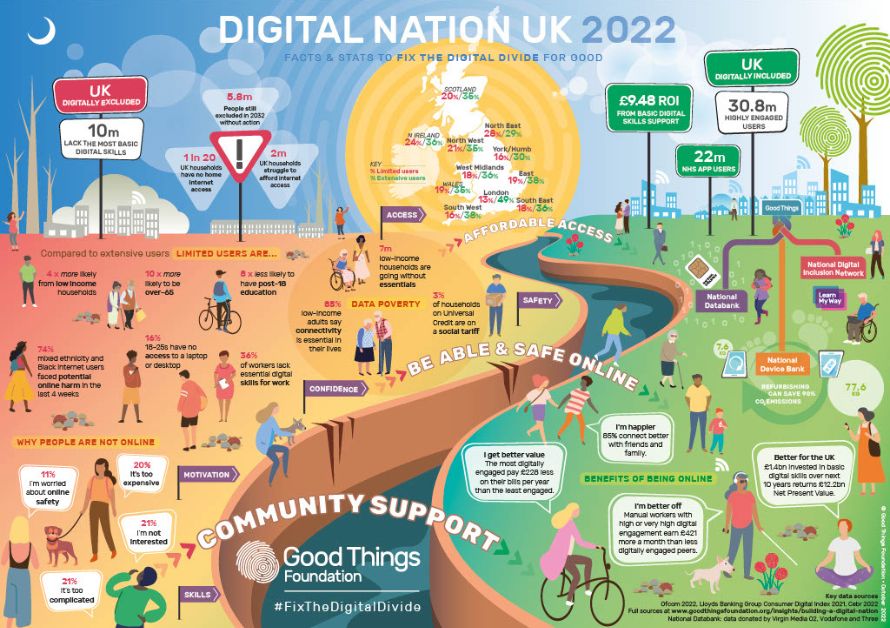
Image courtesy of Good Things Foundation, October 2022. Download the Digital Nation UK 2022 PDF.
Steps already taken to address digital exclusion
By addressing digital exclusion, we can ensure that everyone is offered the opportunity to participate fully in society and to benefit from the opportunities that the digital world has to offer. Steps taken towards this during the pandemic include:
Free digital devices and internet
Community based and government led initiatives that provided free digital devices and internet services to families across the country when the schools closed due to lockdowns.
Digital training and support
Digital literacy training and support, which is also an important factor in people having the skills and confidence to fully utilise internet services.
Louise, Community Coordinator for Blacklands supported a group of people to come together once a week to take part in chair-based exercise for several years prior to the pandemic. When restrictions were first imposed the group stopped meeting and while they were sad to miss out on the physical activity that had become part of their weekly routines, they also missed the social aspects of coming together as a group. Through working with individual members Louise was able to understand each person’s digital literacy levels and their access to an internet connection. Louise was then able to provide tailored support so the group could meet in an online space once a week and maintain their social connections.
“I look forward to not only the chair based exercise but also to meeting everyone for a chat” Community member from Blacklands.
Solutions to try and address digital exclusion
There have been variety of approaches and solutions explored by groups, organisations, schools, and businesses across Scotland to try and address digital exclusion:
- Exploring the use of satellite internet, several companies have been operating for up to 15 years providing reliable satellite internet connections to homes and businesses across rural Scotland. This has sometimes been the only option for some, especially in island communities, to achieve a stable internet connection.
- Some internet service providers are responding to the decline in broadband uptake and connection maintenance by offering 30-day rolling contracts, meaning that families aren’t committing themselves to lengthy contracts or forgoing an internet connection for fear of not being able to sustain the connection long term.
- Local groups and organisations have been able to access funding to access or create and provide training and support to the people their work with. Organisations such as Lightburn Elderly Association Project in Cambuslang and Rutherglen distributed over 100 digital devices and provided free internet access to those that needed it and received funding through the Scottish Governments Community Recovery Fund to cover the costs associated with providing specialist staff to support local older people to build capacity around using digital technologies.
Tell us your experience of using online tools and services – public engagement with Digital Exclusion Audit.
However, there is more work required to understand and address digital exclusion. That’s why Corra is pleased to be supporting a review by Audit Scotland to consider how well public bodies understand and are tackling digital exclusion. Corra will be supporting the public engagement element of the review and ensuring people’s lived experiences shape the process at all stages.

Corra will be hosting several focus groups across Argyll & Bute and Renfrewshire council areas. The purpose of the focus groups is to provide an opportunity for people to share their lived experience in using and accessing online tools and services, raise the things that are important to them and help shape the review.
If you’d like to get involved, please drop Cath a message at cath@corra.scot.